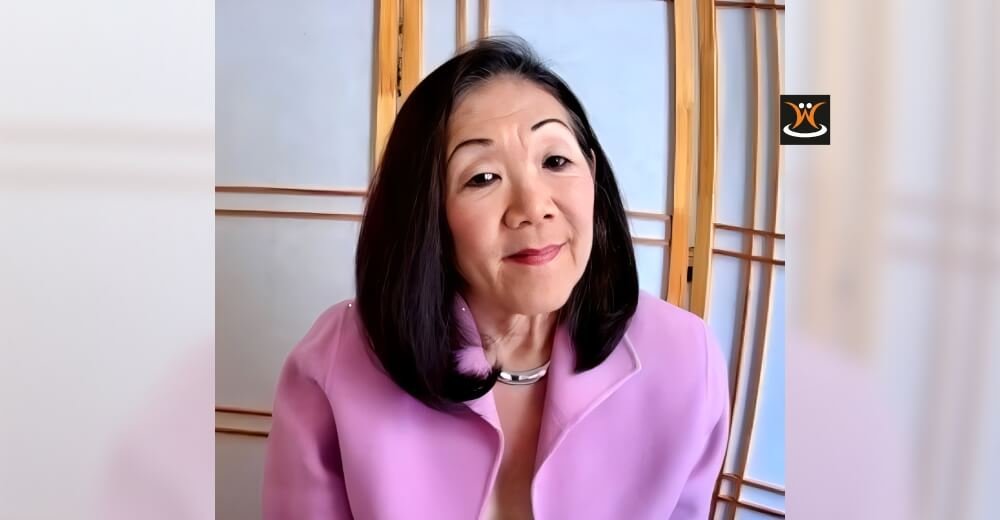
By Sara Ting
Here is an eye-opening question: when we go to school, we are in the classroom to learn — and we have to listen in order to learn. But do you remember, at any point from elementary school through high school, having a formal, structured class that taught you how to listen?
I have been asking people this question for over a decade, and the answer is always the same: No.
Yet authentic listening is essential to our human relationships — to working together, living together in communities, cities, and nations, and solving problems both big and small. It is the foundation of understanding, cooperation, and connection, and yet it is the one skill we assume people will naturally learn on their own.
I want to share a profound experience that revealed how quickly assumptions and bias can replace listening.
Years ago, I was walking out of a major department store, professionally dressed, when two security guards approached me. I asked if there was a problem. One replied, “The sunglasses in your pocket — you stole them.”
I took them out, held them in my hand, and said, “These? No, they’re mine.” But they insisted I had stolen them and told me to follow them. Not wanting to make a scene, I assumed that once we sat down and they looked at the sunglasses, they would realize their mistake.
Instead, inside a small room, they continued to insist I had stolen them. They never examined the sunglasses. They claimed everything was on video. In that moment, I realized I was in a bad situation — two of them, one of me — and they were not listening. They had already decided I was guilty.
I imagined they would show me a video while planting new sunglasses in my bag. At that point, I simply stood up and left.
I later wrote a letter to the President of the company. It was forwarded to the Chairman, who met with me along with the VP of Security. He brought a training manual. Throughout the entire meeting, not once did anyone mention listening. Yet what I experienced was two people who were not truly listening at all. There was an assumption, a bias. I was guilty until proven innocent. And from a common-sense perspective, it is not unusual for a customer to carry their own sunglasses.
This experience is a dramatic example of how people can “listen” through assumption or bias — and how that stops authentic listening for truth or understanding.
The key to true listening is to seek truth and understanding. The kinds of listening that get in the way are listening with:
- assumption
- bias
- judgment
- suspicion
- the desire to make the other person wrong
- or not listening at all — simply waiting for your turn to speak
Now more than ever, we need to listen with an open mind, be curious, seek truth and understanding, and have the humility to learn.
How many marriages have ended because of poor communication?
Making decisions — especially critical ones — requires listening with an open mind. And solving any problem, big or small, depends on it. Yet countless tragedies have occurred because of a breakdown in human communication. Again and again, investigations reveal the same pattern: someone tried to warn of a risk, but their voice was dismissed because they lacked the “right” title or stood too low in the organizational hierarchy. Their insight was clear, their concern was real, but status — not truth — determined whether they were heard.
Another powerful example of the cost of not listening comes from the Challenger space shuttle tragedy. Before the launch, an engineer warned that the O-rings — a small but essential part of the shuttle — could fail in cold weather. He urged NASA leadership to delay the launch. But because he did not have the “right” title and was lower in the organizational hierarchy, his warning was dismissed.
The O-rings did fail. And the Challenger exploded.
This tragedy is a heartbreaking reminder that when people listen with bias, assumption, or hierarchy — instead of curiosity and openness — the consequences can be devastating. A single voice, even one without status, may hold the truth that prevents disaster.
Now more than ever, in a world where politics, ideology, and the digital noise of social media compete for our minds and ears, we must cultivate authentic listening.
We especially need to listen when someone holds a political point of view that is diametrically opposite to our own. Instead of tuning out or attacking their position, we can ask questions to understand and offer perspectives they may not have considered. The goal is to listen to understand — not to change someone’s mind, demonize them, or make them wrong.
One last important point: when you hear the word no, don’t let it stop you from pursuing your goal or dream. Too many of us let that one word shut us down. Listen more deeply to yourself — to what is driving you. Ask yourself, Why am I doing this? Listen to the quiet, divine voice inside each of us that knows the right choices and the right path. We just need to be still enough to hear it.
There is listening to the outside world, and there is listening to your inner world — the most important one, because it is with you all the time.
We need to wash our minds and ears each day — to begin with an open mind as wide as the sky, and a fresh pair of quiet ears, like the stillness that lets us hear a breeze at dawn.
Be curious. Be eager to learn. Be quick to listen before speaking or passing judgment. Cultivate human connection. Seek truth, justice, what is right, and deep understanding.
You will know you have truly listened when you can walk away from a conversation and feel at peace with yourself.
About the Author:
Sara Ting, Chinese American, graduate of Boston University, former TV reporter, president and founder of World Unity Inc., author, poet, TEDx Speaker, and Diversity Trainer, believes in God. She has dedicated her life to bringing her Sun Poem to the world and building a landmark showcasing it to impact future generations – “Are you greater than the sun/that shines on everyone: Black, Brown, Yellow/, Red, and White/the sun does not discriminate.”